The Hybrid Architecture: QPU as Accelerator
A first pass. Incomplete by design.
The model
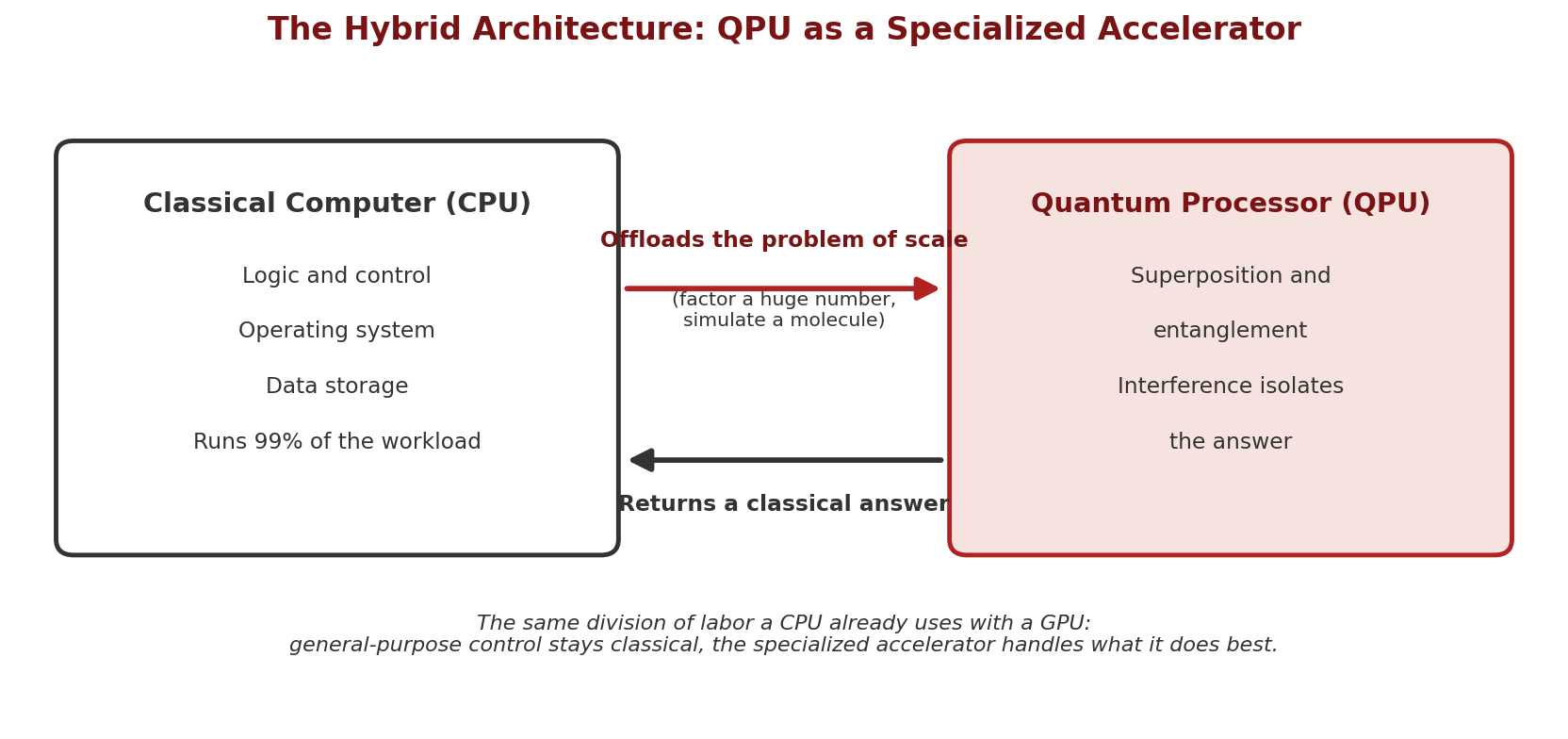
The goal of quantum computing is not to replace classical computers but to complete them. In the emerging model a quantum processing unit (QPU) sits beside the CPU as a specialized accelerator. The classical machine runs the operating system, logic, and data storage, and dispatches to the QPU only when it reaches a subproblem of the right shape: factoring a large number, simulating a molecule, sampling from a distribution that is hard to prepare classically.
Why the analogy to GPUs is accurate and where it fails
It is accurate about the division of labor: general-purpose control stays classical, and the accelerator handles what it does best. It fails on the nature of the result. A GPU returns deterministic output. A QPU returns a sample from a probability distribution shaped by interference, so a hybrid workflow usually includes repetition and classical post-processing (as in Shor's continued-fraction step).
What decides which problems go to the QPU
The The Structure GradientNoteSeedThe Structure GradientComputational advantage depends on how much structure a problem has and where the structure comes from: isomorphic (the problem is physics), structural (hidden mathematical regularity), or generic (nothing to exploit). Derived, borrowed, or learned.. Problems isomorphic to quantum physics, or with hidden mathematical structure, are candidates. Generic search is usually not worth the round trip.
What this note does not yet cover
- Current cloud access models (IBM, Google, IonQ, Quantinuum) and what "hybrid" means in practice today.
- Variational loops where the classical optimizer and QPU alternate.
Review log
- 2026-09-08: seeded from Section IX of The Resolution of Reality.
Appears in
Essays that draw on this note.
- The Resolution of RealityA primer on quantum computing: how physical law replaces brute-force search, why the advantage depends on how native the problem is to the machine, and where hybrid classical-quantum architectures fit.
Links out
- The Structure GradientComputational advantage depends on how much structure a problem has and where the structure comes from: isomorphic (the problem is physics), structural (hidden mathematical regularity), or generic (nothing to exploit). Derived, borrowed, or learned.
Related
- Qubit Hardware: The Five Leading ApproachesSuperconducting circuits, trapped ions, photons, silicon spins, and topological qubits: what each is, the trade-off each makes, and who is building it. Originally Appendix C of The Resolution of Reality.
- Key Quantum Algorithms: Shor, Grover, and SimulationThe three algorithm families that define what quantum computers are for, the speedup each delivers, and why the speedups differ. Originally Appendix D of The Resolution of Reality.