The Structure Gradient
A first pass. Incomplete by design.
Part of the track Derived, Borrowed, Learned
The claim
The advantage any computational method offers is proportional to how much structure the problem has and how directly the method can read it. This note holds the vocabulary used across the essays on this site.
The gradient for quantum computing
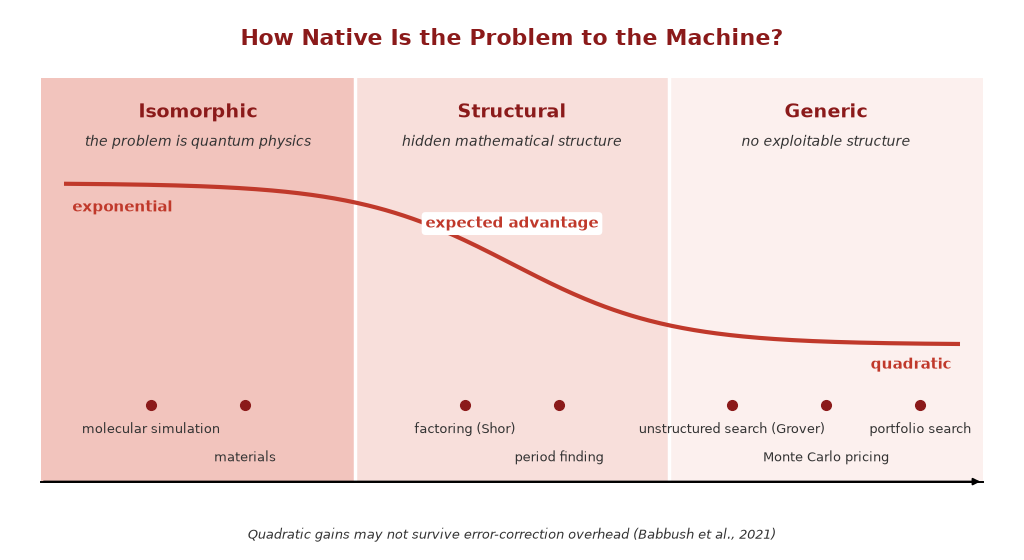
| Zone | What the structure is | Example | Advantage |
|---|---|---|---|
| Isomorphic | The problem is itself quantum physics | Molecular simulation | Exponential, best supported |
| Structural | A hidden mathematical regularity (a period, a symmetry) | Factoring via Shor | Exponential, problem-specific |
| Generic | None the machine can exploit | Unstructured search, Monte Carlo pricing | Quadratic, may not survive error-correction overhead |
Most finance applications proposed so far sit in the generic zone. See Key Quantum Algorithms: Shor, Grover, and SimulationNoteGrowingKey Quantum Algorithms: Shor, Grover, and SimulationThe three algorithm families that define what quantum computers are for, the speedup each delivers, and why the speedups differ. Originally Appendix D of The Resolution of Reality. and Analog Computation and IsomorphismNoteSeedAnalog Computation and IsomorphismAn analog computer is one that is analogous to the problem: the wind tunnel to flight, the tide machine to the sea. When the analogy is exact the word is isomorphism, and a quantum simulator is the deepest example..
The wider version: derived, borrowed, learned
Across the three essays on this site the same gradient appears as three ways of getting structure into a computation:
- Derived. Mathematics derives structure from first principles: a differential equation, a Fourier basis, a stochastic calculus. This is the story of From Smooth to JaggedEssayFrom Smooth to JaggedHow mathematics grew a new tool each time reality posed a problem the existing math could not solve, from Taylor series to the Fourier transform, stochastic calculus, fractal geometry, and rough paths, ending with a personal encounter with Benoit Mandelbrot and its bearing on reading markets..
- Borrowed. Quantum simulation borrows structure from physics, when the problem is isomorphic to a physical system. This is the ending of The Resolution of RealityEssayThe Resolution of RealityA primer on quantum computing: how physical law replaces brute-force search, why the advantage depends on how native the problem is to the machine, and where hybrid classical-quantum architectures fit..
- Learned. Machine learning learns structure from data, when nobody can derive it and nothing in nature happens to compute it. This is the subject of From Prediction to AgencyEssayFrom Prediction to AgencyA draft essay on frontier language models: each stage in their development answered a limit hit by the previous one, and each answer changed what a model is. It ends with the question the companion essays set up: whether a learned model of human behavior could become a substrate for markets, and why reflexivity puts a ceiling on that..
Markets are the case where only the third route has been open. There is no substrate to borrow from, and derivation has so far produced better approximations rather than a solution. Whether learned models of human behavior could eventually become a borrowed substrate for markets is an open question, bounded by ReflexivityNoteSeedReflexivityA model of a market changes the market. Soros's reflexivity, the Lucas critique, and Goodhart's law are three statements of the same limit, and it is the one way markets are permanently harder than chemistry: molecules do not read the paper..
Review log
- 2026-09-08: seeded as the library-level framing note.
Appears in
Essays that draw on this note.
- The Resolution of RealityA primer on quantum computing: how physical law replaces brute-force search, why the advantage depends on how native the problem is to the machine, and where hybrid classical-quantum architectures fit.
Links out
- Key Quantum Algorithms: Shor, Grover, and SimulationThe three algorithm families that define what quantum computers are for, the speedup each delivers, and why the speedups differ. Originally Appendix D of The Resolution of Reality.
- Analog Computation and IsomorphismAn analog computer is one that is analogous to the problem: the wind tunnel to flight, the tide machine to the sea. When the analogy is exact the word is isomorphism, and a quantum simulator is the deepest example.
- From Smooth to JaggedHow mathematics grew a new tool each time reality posed a problem the existing math could not solve, from Taylor series to the Fourier transform, stochastic calculus, fractal geometry, and rough paths, ending with a personal encounter with Benoit Mandelbrot and its bearing on reading markets.
- The Resolution of RealityA primer on quantum computing: how physical law replaces brute-force search, why the advantage depends on how native the problem is to the machine, and where hybrid classical-quantum architectures fit.
- From Prediction to AgencyA draft essay on frontier language models: each stage in their development answered a limit hit by the previous one, and each answer changed what a model is. It ends with the question the companion essays set up: whether a learned model of human behavior could become a substrate for markets, and why reflexivity puts a ceiling on that.
- ReflexivityA model of a market changes the market. Soros's reflexivity, the Lucas critique, and Goodhart's law are three statements of the same limit, and it is the one way markets are permanently harder than chemistry: molecules do not read the paper.
Referenced by
Other notes and pages that link here.
- Analog Computation and IsomorphismAn analog computer is one that is analogous to the problem: the wind tunnel to flight, the tide machine to the sea. When the analogy is exact the word is isomorphism, and a quantum simulator is the deepest example.
- Derived, Borrowed, LearnedThree ways of getting structure into a computation. Mathematics derives it, quantum simulation borrows it from physics, machine learning learns it from data. Three essays and the notes between them, in reading order.
- Key Quantum Algorithms: Shor, Grover, and SimulationThe three algorithm families that define what quantum computers are for, the speedup each delivers, and why the speedups differ. Originally Appendix D of The Resolution of Reality.
- Quantum SimulationFeynman's 1982 proposal and Lloyd's 1996 proof: a quantum computer can efficiently simulate any local quantum system. The case where the machine and the problem share the same physics.
- RSA and the Factoring ProblemHow RSA turns the difficulty of factoring into a lock, why the lock has a hidden period, and a worked example with small numbers. Originally Appendix A of The Resolution of Reality.
- The Hybrid Architecture: QPU as AcceleratorQuantum processors will be called by classical systems for the specific subproblems they are native to, the way a CPU offloads to a GPU. The classical side keeps control, logic, and storage.
Related
- Quantum SimulationFeynman's 1982 proposal and Lloyd's 1996 proof: a quantum computer can efficiently simulate any local quantum system. The case where the machine and the problem share the same physics.
- World models: two meanings of one termThe phrase 'world model' now covers two different research programs: a learned dynamics model an agent plans inside, and a generative model of visual or 3D space. This note separates them and explains why the distinction matters.