Fourier Transform
A first pass. Incomplete by design.
Part of the track Derived, Borrowed, Learned
The claim
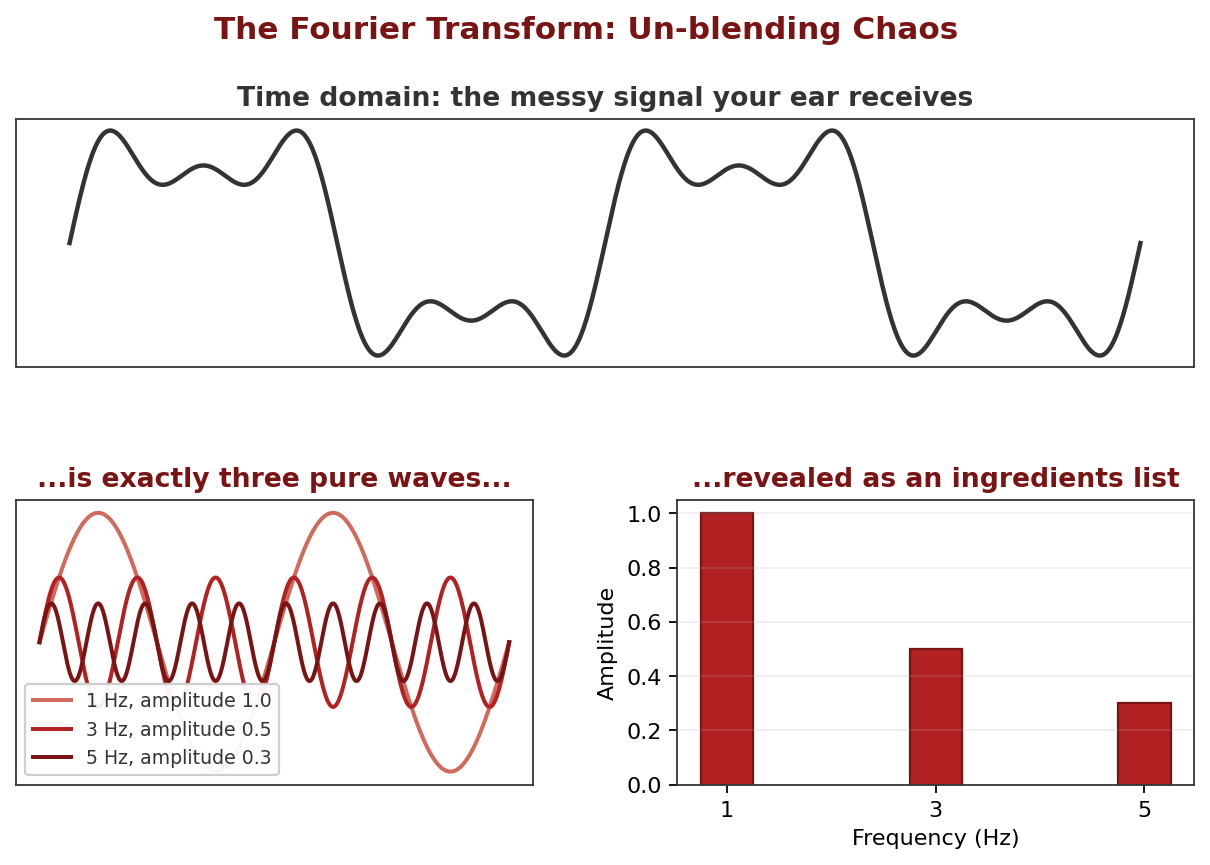
A signal in the time domain, however irregular, can be rebuilt from pure oscillations. The transform is the resonance probe that finds them:
X(f) = ∫ x(t) e^(−i2πft) dt, over all t
The time domain records when things happened; the frequency domain records which pure notes are present and at what strength. Same information, two descriptions.
A physical instance
The cochlea is a mechanical Fourier transform. Each position along the coiled membrane resonates with one frequency, so a chord arriving as a single pressure wave is separated into notes before the brain is involved. Noise-cancelling headphones and song-recognition software run the same decomposition in silicon.
History
Fourier presented the idea in 1807 to solve the heat equation. Lagrange rejected it; Laplace was skeptical and later came around. The full theory appeared in 1822. The Gibbs phenomenon (overshoot at sharp edges) and the conditions for convergence took decades more to settle.
The connection to quantum computing
Shor's algorithm is period finding, and period finding is a Fourier transform: a periodic function has a spectrum concentrated at multiples of its fundamental frequency. The Quantum Fourier Transform performs the decomposition over 2^n amplitudes in one interference step. See Shor's Algorithm and the Quantum Fourier TransformNoteSeedShor's Algorithm and the Quantum Fourier TransformShor's algorithm is period finding: prepare a superposition, apply the periodic function, and read off the period with a Fourier transform. It is the bridge between the quantum primer and the mathematics essay.. This is the tightest link between the two essays on this site.
Where it fails
The transform assumes stationarity: the frequency content does not change over the window. For signals whose character shifts in time (speech, prices), windowed and wavelet transforms take over. For paths too rough to have a useful spectrum at all, see Rough Path TheoryNoteSeedRough Path TheoryLyons (1998): a rough path alone does not determine the integrals along it, so enrich the path with its iterated integrals. Once you do, differential equations driven by paths of any roughness become well defined, with no probability required..
Review log
- 2026-09-08: seeded from Section III of From Smooth to Jagged.
Appears in
Essays that draw on this note.
- From Smooth to JaggedHow mathematics grew a new tool each time reality posed a problem the existing math could not solve, from Taylor series to the Fourier transform, stochastic calculus, fractal geometry, and rough paths, ending with a personal encounter with Benoit Mandelbrot and its bearing on reading markets.
Links out
- Shor's Algorithm and the Quantum Fourier TransformShor's algorithm is period finding: prepare a superposition, apply the periodic function, and read off the period with a Fourier transform. It is the bridge between the quantum primer and the mathematics essay.
- Rough Path TheoryLyons (1998): a rough path alone does not determine the integrals along it, so enrich the path with its iterated integrals. Once you do, differential equations driven by paths of any roughness become well defined, with no probability required.
Referenced by
Other notes and pages that link here.
- Shor's Algorithm and the Quantum Fourier TransformShor's algorithm is period finding: prepare a superposition, apply the periodic function, and read off the period with a Fourier transform. It is the bridge between the quantum primer and the mathematics essay.
Related
- Taylor SeriesReconstruct a smooth function from its derivatives at one point. The first tool mathematics built for prediction, and the one that assumes the world is smooth.