Taylor Series
A first pass. Incomplete by design.
Part of the track Derived, Borrowed, Learned
The claim
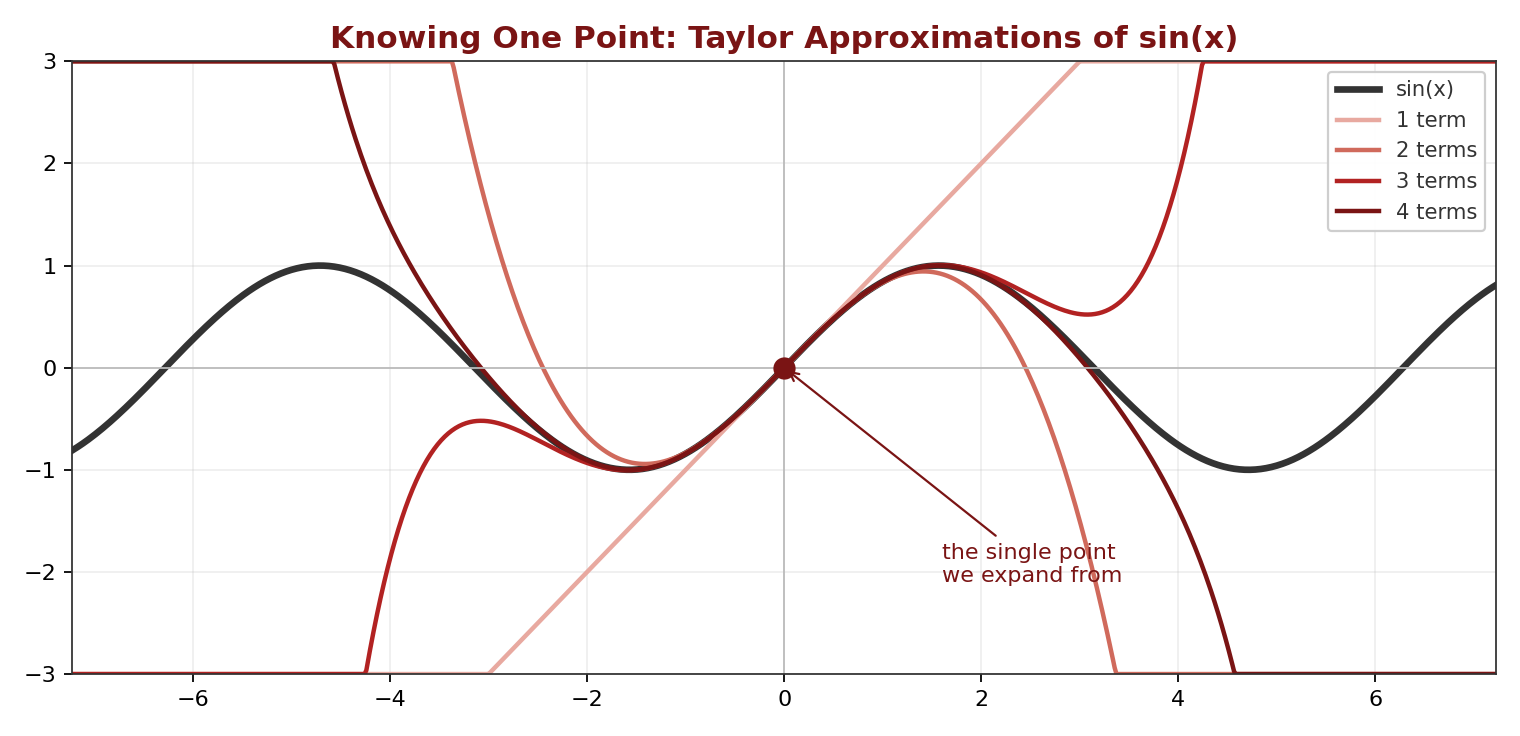
If you know every derivative of a well-behaved function at a single point a, you can reconstruct the function everywhere within its radius of convergence:
f(x) = Σ [ f⁽ⁿ⁾(a) / n! ] (x − a)ⁿ, summed from n = 0 to ∞
Local information determines global behavior. That is the strongest form of the smooth-world assumption.
Why it works so often: symmetry
At a stable equilibrium the first derivative is zero, so the leading surviving term is quadratic. A pendulum near rest, a spring, a chemical bond, and a bridge deck all obey the same quadratic law near equilibrium for that reason. Even and odd symmetry kill further terms: the cosine expansion has no odd powers before anyone does any algebra.
The derivatives as physical layers
Position, velocity, acceleration, jerk (third derivative), snap (fourth). Elevator and roller-coaster designers limit jerk and snap explicitly, because the inner ear feels those layers rather than speed.
Where it fails
- Non-analytic functions. e^(−1/x²) is smooth at zero and every derivative there is zero, so the series predicts nothing.
- Non-differentiable paths. A Brownian path has no derivative anywhere, so there is no expansion to write. This is the failure that motivates Brownian Motion and Itô CalculusNoteSeedBrownian Motion and Itô CalculusA path continuous everywhere and differentiable nowhere broke ordinary calculus. Itô's lemma repaired it with one extra term, tuned exactly to Brownian roughness. and, further out, Rough Path TheoryNoteSeedRough Path TheoryLyons (1998): a rough path alone does not determine the integrals along it, so enrich the path with its iterated integrals. Once you do, differential equations driven by paths of any roughness become well defined, with no probability required., which reconstructs what can be done with a jagged path from its iterated integrals instead of its derivatives.
History
Brook Taylor published the series in 1715. Its public triumph was Clairaut's 1758 prediction of Halley's comet, computed by perturbation series and correct to within about a month.
Review log
- 2026-09-08: seeded from Section II of From Smooth to Jagged.
Appears in
Essays that draw on this note.
- From Smooth to JaggedHow mathematics grew a new tool each time reality posed a problem the existing math could not solve, from Taylor series to the Fourier transform, stochastic calculus, fractal geometry, and rough paths, ending with a personal encounter with Benoit Mandelbrot and its bearing on reading markets.
Links out
- Brownian Motion and Itô CalculusA path continuous everywhere and differentiable nowhere broke ordinary calculus. Itô's lemma repaired it with one extra term, tuned exactly to Brownian roughness.
- Rough Path TheoryLyons (1998): a rough path alone does not determine the integrals along it, so enrich the path with its iterated integrals. Once you do, differential equations driven by paths of any roughness become well defined, with no probability required.
Referenced by
Other notes and pages that link here.
- Rough Path TheoryLyons (1998): a rough path alone does not determine the integrals along it, so enrich the path with its iterated integrals. Once you do, differential equations driven by paths of any roughness become well defined, with no probability required.
- The Mandelbrot SetIterate z → z² + c and ask whether the orbit stays bounded. The boundary between staying and escaping is infinitely intricate, and it is a picture of where prediction fails.
Related
- Fourier TransformAny physically realistic signal is a sum of sines and cosines; the transform recovers which ones and how strongly. Built to solve the heat equation, it is also the engine of Shor's algorithm.