Brownian Motion and Itô Calculus
A first pass. Incomplete by design.
Part of the track Derived, Borrowed, Learned
The object
Robert Brown watched pollen jitter in water in 1827. Einstein explained the jitter in 1905 as the statistical signature of molecular collisions, an argument quantitative enough to settle the existence of atoms. The mathematical model is the Wiener process W(t): continuous, with independent Gaussian increments whose variance grows linearly in time.
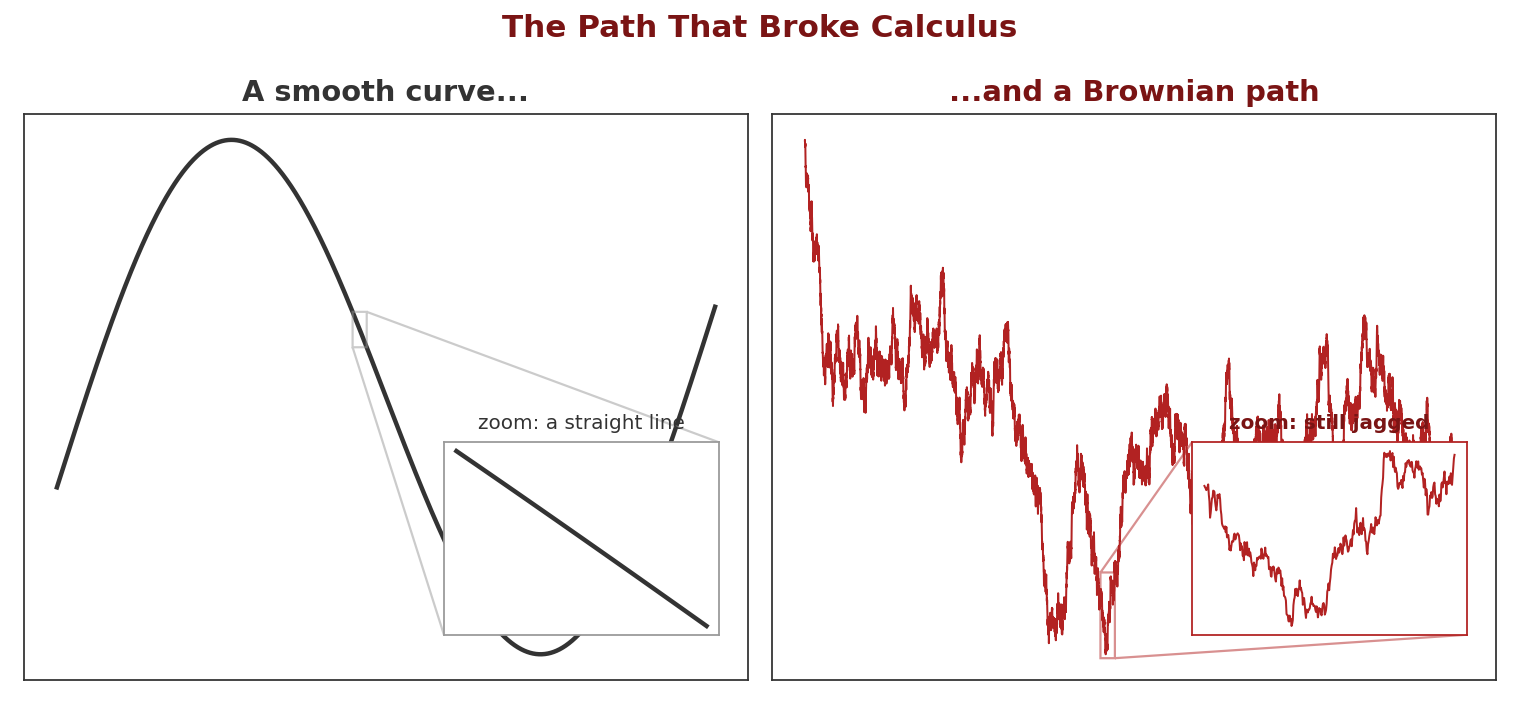
Why calculus breaks
Zoom into a smooth curve and it flattens into a line; that line's slope is the derivative. Zoom into a Brownian path and it stays exactly as jagged at every scale. There is no line and no derivative, so dx/dt has no meaning and ordinary differential equations cannot be written.
Itô's repair
Itô (1944) added a third infinitesimal, dW, alongside dx and dt, and worked out its rules. The key one is that (dW)² behaves like dt, not like dt². Squared random steps do not vanish. The result is Itô's lemma, the stochastic chain rule:
df = ( ∂f/∂t + μ ∂f/∂x + ½σ² ∂²f/∂x² ) dt + σ (∂f/∂x) dW
The ½σ² term exists only because randomness accumulates at the square-root rate. It is not an adjustment bolted onto the model; it is what the calculus of jagged paths looks like.
Finance
Bachelier wrote down the random-walk model of prices in his 1900 thesis, five years before Einstein's paper. It received the grade honorable rather than très honorable and was largely ignored until Savage and Samuelson revived it in the 1950s. Itô's calculus applied to Bachelier's idea yields Black-Scholes (1973), which is itself a stochastic differential equation.
Where Itô's calculus fails
The one extra term is tuned to a path whose squared increment scales like dt, which means Hurst exponent H = 0.5. For any other H, (dW_H)² scales like dt^2H: the term vanishes for H > 0.5 and diverges for H < 0.5, and the path is no longer a semimartingale, so the Itô integral is not defined. See Hurst Exponent and Fractal DimensionNoteSeedHurst Exponent and Fractal DimensionTwo measurements of roughness that are one measurement: for a self-affine path, D = 2 − H. A random walk has H = 0.5 and D = 1.5; anything else is a path of another roughness. for the measurement and Rough Path TheoryNoteSeedRough Path TheoryLyons (1998): a rough path alone does not determine the integrals along it, so enrich the path with its iterated integrals. Once you do, differential equations driven by paths of any roughness become well defined, with no probability required. for the repair.
Review log
- 2026-09-08: seeded from Section IV of From Smooth to Jagged.
Appears in
Essays that draw on this note.
- From Smooth to JaggedHow mathematics grew a new tool each time reality posed a problem the existing math could not solve, from Taylor series to the Fourier transform, stochastic calculus, fractal geometry, and rough paths, ending with a personal encounter with Benoit Mandelbrot and its bearing on reading markets.
Links out
- Hurst Exponent and Fractal DimensionTwo measurements of roughness that are one measurement: for a self-affine path, D = 2 − H. A random walk has H = 0.5 and D = 1.5; anything else is a path of another roughness.
- Rough Path TheoryLyons (1998): a rough path alone does not determine the integrals along it, so enrich the path with its iterated integrals. Once you do, differential equations driven by paths of any roughness become well defined, with no probability required.
Referenced by
Other notes and pages that link here.
- Rough Path TheoryLyons (1998): a rough path alone does not determine the integrals along it, so enrich the path with its iterated integrals. Once you do, differential equations driven by paths of any roughness become well defined, with no probability required.
- Taylor SeriesReconstruct a smooth function from its derivatives at one point. The first tool mathematics built for prediction, and the one that assumes the world is smooth.
Related
- Taylor SeriesReconstruct a smooth function from its derivatives at one point. The first tool mathematics built for prediction, and the one that assumes the world is smooth.